Most B2B lead generation works like fishing with a net that has holes the size of your fist. Run LinkedIn ads, capture form fills, maybe buy a list. The leads that come in might be qualified or they might not. Your SDR team spends hours checking company websites, looking up titles and deciding whether each lead is worth a call. That time comes straight out of selling time.
An AI lead enrichment system automates that research layer. It spots buying signals across public data sources, enriches each lead profile with firmographics and intent data, scores them against your ideal customer profile, and routes the best ones to the right person on your team. Gartner's B2B buying journey research shows that B2B buyers spend only a small share of their total purchase process actually meeting with potential suppliers, and most of their time goes into independent research instead. Enrichment helps your team show up at the right moment with the right context.
No single signal tells you much on its own. A job change, a pricing page visit, a funding round: any one of these could mean nothing. It is the combination that predicts intent, which is why the framework below treats signal detection as the first stage, not the whole system.
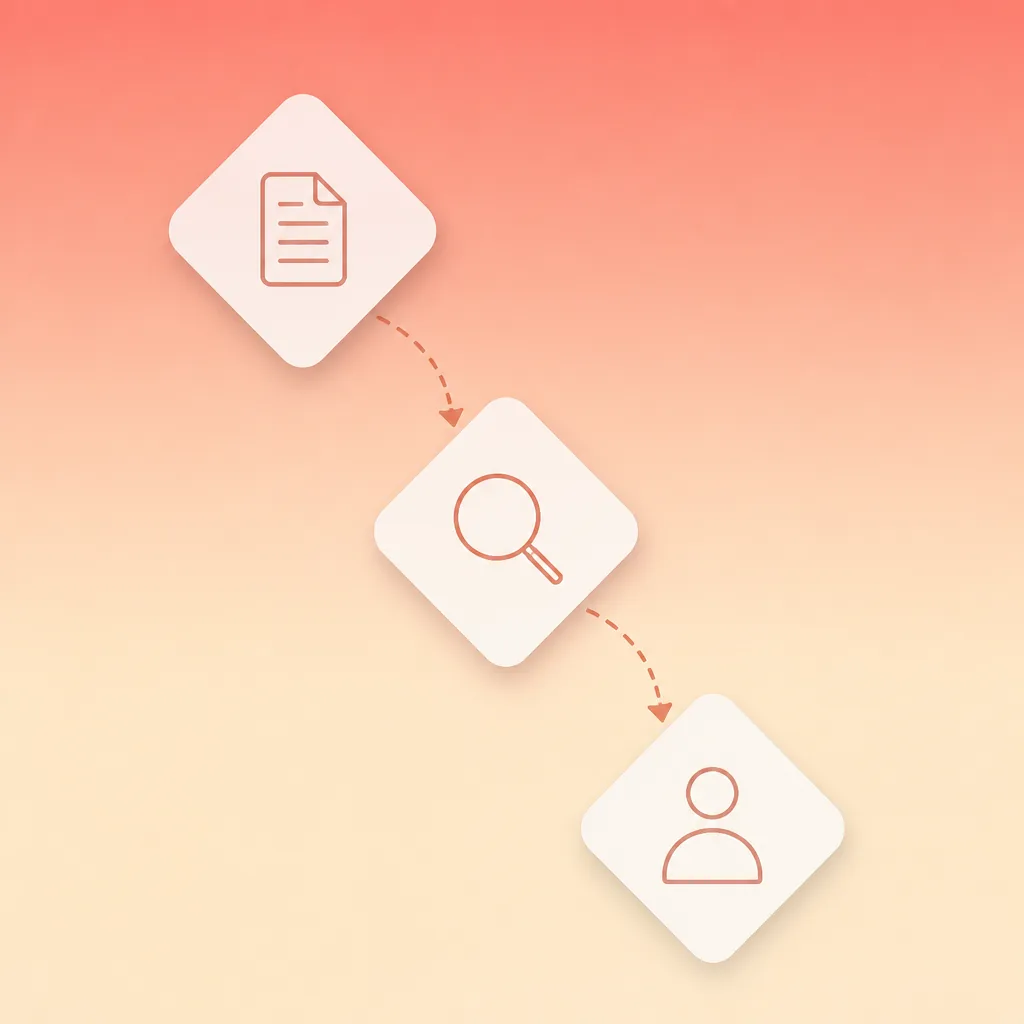
It has four stages. Each one builds on the one before it, and each can be set up independently depending on where your lead gen process breaks down most often.
Buying intent shows up before the contact form does
Buying intent shows up in a dozen places before someone fills out your contact form. A company hires a new director of marketing. They get a funding round. Someone from their domain reads three of your blog posts in a week. Their usage of a complementary tool spikes. Each of these is a weak signal on its own, but together they form a pattern that predicts purchase intent better than any single trigger.
AI signal detection monitors these sources continuously and alerts your team when a threshold is crossed. You set the thresholds based on your ideal customer profile. The system does the watching. Your team only gets a notification when the signal matters.
A bare contact record becomes thirty to fifty data points
Once a signal is detected, the system builds a complete lead profile. It starts with whatever data you already have: an email address, a company name, a LinkedIn URL. It enriches that record from public and partner sources. Company size, industry, technology stack, recent hires, funding history, content consumption patterns, social media activity. The output is a lead record with 30 to 50 data points instead of the 3 to 5 you started with, which is roughly the same shift HubSpot describes in its definition of lead enrichment: appending firmographic, technographic and behavioural data to a bare contact record.
The enrichment happens in seconds. By the time the lead enters your CRM, it already has enough context for your SDR to have an informed conversation on the first call. For a practical implementation of this pattern, our cold email personalisation guide walks through pulling firmographic and technographic data with Claude and Hunter.io before outreach.
Scoring that learns which leads actually close
Not all enriched leads are worth the same follow-up effort. The AI model scores each lead against your historical conversion data. It learns what combinations of signals predict a closed deal: a director-level title at a company with 50 to 200 employees that uses a competitor's tool and visited your pricing page three times in a week.
The scoring model improves over time. Every time a lead converts or drops off, the system adjusts its weights. After three months of operation, the score reflects not just static fit criteria but dynamic buying behaviour specific to your market. Across the enrichment work we have done at Supernodes, this typically shows up as three to five times more qualified leads reaching sales, and roughly ten hours a week clawed back per SDR from manual research.
Routing by score, capacity and territory
The final stage gets the right lead to the right person at the right time. High-scoring inbound leads go to your top performers within minutes of enrichment. Mid-scoring leads enter a nurture sequence. Low-scoring leads stay in the database for batch outreach when capacity allows.
Routing rules match lead scores to rep capacity, deal size thresholds and territory assignments. The system handles the distribution. Your team handles the conversation. Our lead qualification agent guide covers building an automated routing system that scores and assigns leads based on enrichment data.
How it compounds over time
The four-stage framework is not a one-time setup. The enrichment layer gets richer as you add more signal sources. The scoring model gets more accurate as you close more deals. The routing gets more efficient as you learn which lead types convert fastest.
The critical thing to understand is that enrichment does not replace your sales team. It replaces the administrative overhead that keeps them from selling. An SDR who starts their day with a prioritised list of enriched, scored and routed leads is not spending the first hour of every morning on company website research. HubSpot's 2025 State of Sales Report found that 68 per cent of sales teams say lead quality improved year over year, which tracks with what better context at first contact does to a rep's win rate.
| Without enrichment | With enrichment |
|---|---|
| 3 to 5 data points per lead (name, email, company) | 30 to 50 data points (firmographics, tech stack, intent signals) |
| SDR researches each lead manually before the first call | SDR opens a lead record that already has the context |
| Every lead gets the same follow-up cadence | High-scoring leads are routed within minutes |
| Scoring criteria stay fixed until someone updates them | Scoring weights adjust as leads convert or drop off |
Where to start without a vendor
Audit your current lead data. Pull 50 leads from your CRM and check how many have complete firmographic information. If fewer than 70 per cent have company size, industry and technology stack filled in, you have an enrichment gap.
Identify your top three buying signals. What behaviours correlate most strongly with closed deals in your historical data? Page visits? Content downloads? Job changes? Funding rounds? Pick the three that matter most and set up monitoring for them.
Score your existing pipeline. Run your current leads through a simple scoring model based on your ideal customer profile. If the top 20 per cent by score are getting the same treatment as the bottom 20 per cent, you have a routing problem.
This is something we do at Supernodes. A two-week pilot covers audit, connect, deploy and measure. Speak with us if your lead gen process needs a smarter foundation.
Frequently asked questions
How is AI lead enrichment different from a simple LinkedIn search?
LinkedIn search shows you who matches your filters right now. AI enrichment monitors signals continuously: a job change, a funding announcement, a website visit pattern. It alerts you when someone starts behaving like a buyer, not just when they match a static profile.
How long does it take to set up AI lead enrichment?
The foundation can be live in two weeks. The Supernodes pilot covers audit, connect, deploy and measure. Most teams see a meaningful pipeline impact within 30 days.
Do I need a large data team to manage AI lead enrichment?
No. The AI layer handles signal detection, enrichment and scoring automatically. Your team reviews the prioritised list and decides who to contact.
Does AI enrichment replace my CRM?
No. The enrichment layer sits on top of your CRM and feeds enriched lead profiles into it. Your CRM stays the system of record. The enrichment layer makes sure it has complete, current data.
What kind of enrichment data does the AI pull?
Company firmographics, technology stack, recent funding, job changes, intent signals from content consumption, social media activity and public records. The system pulls from multiple public and partner data sources.