Plenty of Meta and Google accounts still run the creative set that went live when the campaign launched. A handful of images and headlines carry the whole budget, click-through rates drift down over the following weeks, and nobody can say whether the creative is tired or the audience is. AI ad creative testing fixes that by turning creative into a schedule: generate a batch of variations, test them, keep the winners and write the next brief from the results.
Most advertisers already have the first half of that loop. IAB research published in 2026 found 83 per cent of ad executives say their company has deployed AI in the creative process, up from 60 per cent in its 2024 study. Generating copy is the easy part. The gap is in running structured tests on what the AI produces and feeding the results back into the next brief.
This is about giving your creative team an AI system that handles the volume, the repetition and the analysis so they can spend their time on strategy.
What happens when creative is not tested
Ad creative fatigue shows up first on Meta, where the same people see the same ad again and again. Frequency, the average number of times each person has seen your ad, climbs while click-through rate slides. We looked for a credible public benchmark for the frequency at which the slide starts and found sources that disagree by a wide margin, so we do not quote one here. Watch the two lines in your own account and refresh when they cross.
On Google, the loss is quieter. Responsive Search Ads (RSAs) take up to 15 headlines and 4 descriptions, and Google's help page on responsive search ads says advertisers who raise an RSA's Ad Strength from "Poor" to "Excellent" get 15 per cent more clicks and conversions on average. That figure is Google's own. The same page says the more headlines and descriptions you enter, the more chances Google Ads has to match an ad to the search, so an RSA with five near-identical headlines gives the system very little to work with.
Companies that do not test creative end up running tired ads without knowing whether the creative or the audience is the problem, and they miss the small slice of creative that drives most of their conversions. An AI system that generates, launches and measures variations addresses both, because every change goes live with a test attached.
What AI creative testing actually looks like
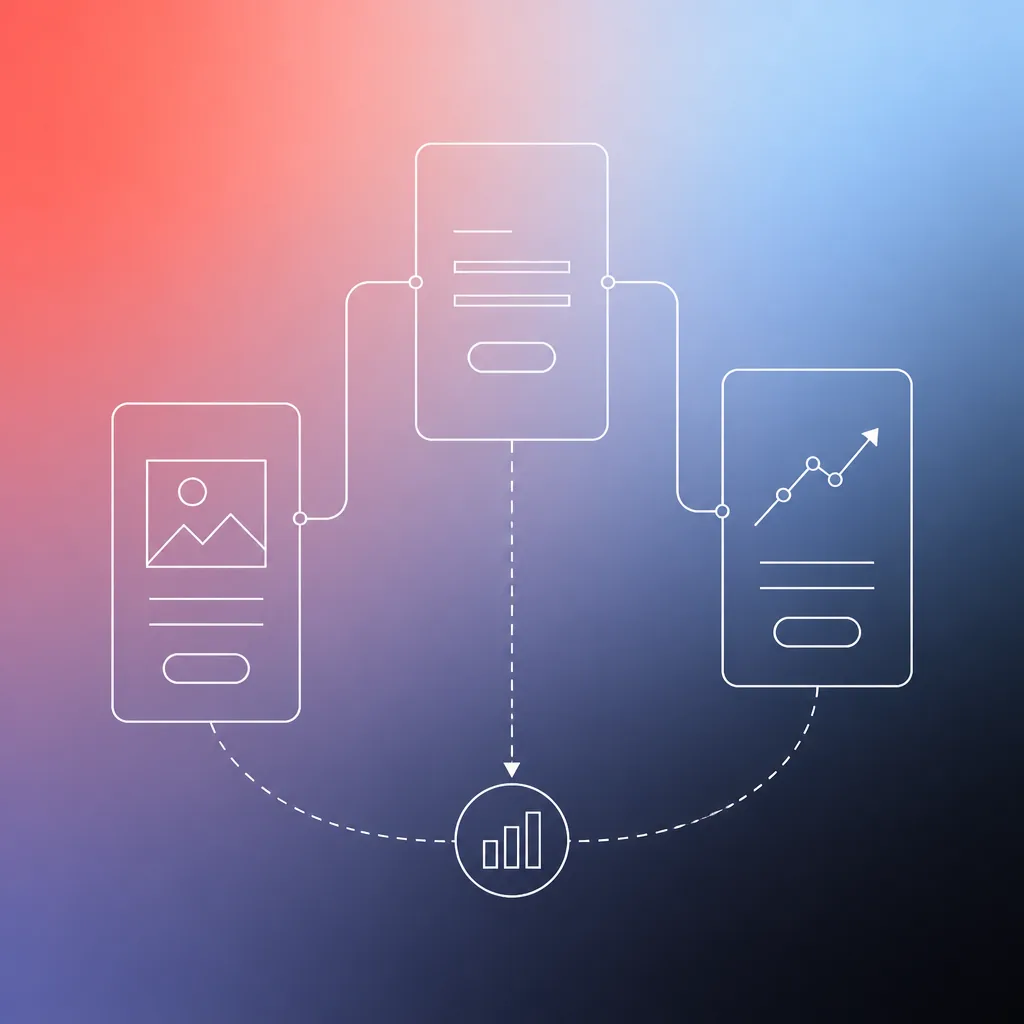
The approach runs on three stages that connect into a weekly cycle.
| Stage | What happens | Where it runs |
|---|---|---|
| Generate | A structured brief produces 10-15 headlines, 5-8 primary texts and 3-5 image concepts | ChatGPT or another LLM |
| Launch | Variations go into each platform's own testing format and run until they have enough data to call | Google Ads responsive search ads, Meta Dynamic Creative or the flexible format |
| Measure and iterate | Winners get budget, losers pause, and the next brief includes the performance data | Your reporting dashboard |
Generate a testing slate from one brief
ChatGPT receives a structured brief covering the offer, the audience, the proof points, the brand voice constraints and a copy framework such as PAS (Problem, Agitate, Solution) or AIDA (Attention, Interest, Desire, Action). Single Grain's ChatGPT ad copy guide recommends stating the channel and format limits in the prompt, for example Google Search headlines of up to 30 characters and descriptions of up to 90. From that brief ChatGPT produces ten to fifteen headline variations, five to eight primary texts and three to five image concepts, and every one of them is raw material for a test.
A tight brief with audience specifics and hard constraints produces variations worth testing, and a vague prompt produces vague copy whichever model you use. The time saving comes from the drafting. A human still picks which variations go live.
Launch the variations where each platform can test them
On Google, the headlines go into a responsive search ad. Google Ads tests combinations over time and learns which ones perform best, and Google's own guidance is to run at least two RSAs with "Good" or "Excellent" Ad Strength in each ad group.
Meta is where the setup has changed under older guides. Dynamic Creative takes up to 10 images or videos plus up to five each of primary text, headlines, descriptions and call-to-action buttons, then assembles them per viewer. AdsUploader's August 2026 guide to Dynamic Creative, from a company that sells a Meta ad upload tool, quotes Meta's notice that since June 2024 Dynamic Creative may not be available for campaigns with the Sales or App promotion objective, and Meta points those advertisers to its flexible ad format, which sits under Advantage+ creative in Ads Manager. If your campaign objective is Sales, plan for the flexible format. A Dynamic Creative ad set also runs a single ad and reports results by element, so it tells you which headline did well across combinations and leaves you without a clean head-to-head between two complete ads. For that, run a separate A/B test, which our Meta ads creative testing framework walks through.
Running ten or more variations a month is a common working volume for accounts that test often. We could not find a published study behind that number, so treat it as the volume that keeps the loop moving. If you are still deciding where to run tests first, our Google Ads vs Meta vs LinkedIn comparison walks through the trade-offs.
Measure, pause and rewrite the brief
At the end of each test cycle, the data shows which angles, formats and offers did best. The winning creative gets more budget and the losing creative is paused. The system improves because the prompt for the next cycle includes the results from the last one, so each brief is tighter than the one before.
We have not found a credible public benchmark that puts a firm number on the gains from creative testing loops as a whole, so we do not quote one. The mechanism itself is in the platforms' own documentation, since both Google's responsive search ads and Meta's Dynamic Creative shift delivery toward the combinations that perform better.
What a testing loop does to your account
The most obvious change is the volume. A team that produces two or three creative concepts a month starts producing ten or more. The bigger change is confidence, because every new creative goes live with a test behind it and the decision about which headline stays is made by the results. For the measurement side of the same problem, our unified attribution guide covers how to tie creative results back to revenue across platforms.
Budget then follows the creative that won the last cycle, which is a better default than spreading it evenly across ads nobody has compared.
Start with one ad set this week
You do not need a full system to start. Try this on one ad set:
Write a brief. One paragraph about the offer, one about the audience, three proof points and one brand voice constraint. Paste it into ChatGPT and ask for ten headlines in the Google Ads format (30 character limit) and four descriptions (90 character limit).
Launch a test. Add the new headlines to a second responsive search ad in the same ad group, with its own final URL as Google's guidance asks, so the group has the two RSAs Google recommends, and compare the two after a few weeks of traffic. For a stricter comparison, a Google Ads custom experiment splits your Search campaign's budget between the original and a trial copy that uses the new ads.
Put a number on the gap. Pull last month's spend by ad and add up what went to the ads with the weakest click-through or conversion rate. That total, from your own account, is the budget a testing loop would move first. Compare it with what running the loop would cost.
This is something we do at Supernodes. A two-week pilot: audit, connect, deploy, measure. You start seeing which creative angles outperform within the first testing cycle. Speak with us if it sounds like your Monday morning.
Frequently asked questions
How many creative variations should I test per month?
Ten or more a month is a common working volume for accounts that test often, but we could not find a published study behind it. The better limit is traffic, because each test needs enough impressions and conversions to separate a winner from noise, so a small account should test fewer variations for longer.
How often should I refresh ad creative?
Refresh when the data says so. On Meta, watch frequency climb while click-through rate falls, and on Google watch the Ad Strength rating and the click-through rate of each responsive search ad. We found no credible public benchmark for a fixed number of weeks, so we do not give one.
Can ChatGPT write good ad copy?
Yes, when given a clear brief with audience, offer, proof points and a copy framework like PAS or AIDA. The best results come from using ChatGPT for volume and variety, then letting A/B test data pick the winners. Single Grain's ChatGPT ad copy guide walks through the exact workflow.
What is the difference between Responsive Search Ads and A/B testing?
Google Responsive Search Ads automatically test headline and description combinations inside a single ad. A/B testing compares entirely different strategies: one headline angle versus another, one offer versus another. Use RSAs for fine-tuning and A/B tests for major creative decisions. Google's responsive search ads help page explains how the combinations are tested.
How long does it take to set up an AI creative testing system?
The foundation of an AI creative testing system takes about two weeks. The Supernodes pilot covers audit, connect, deploy and measure. You start seeing which creative angles outperform within the first testing cycle.