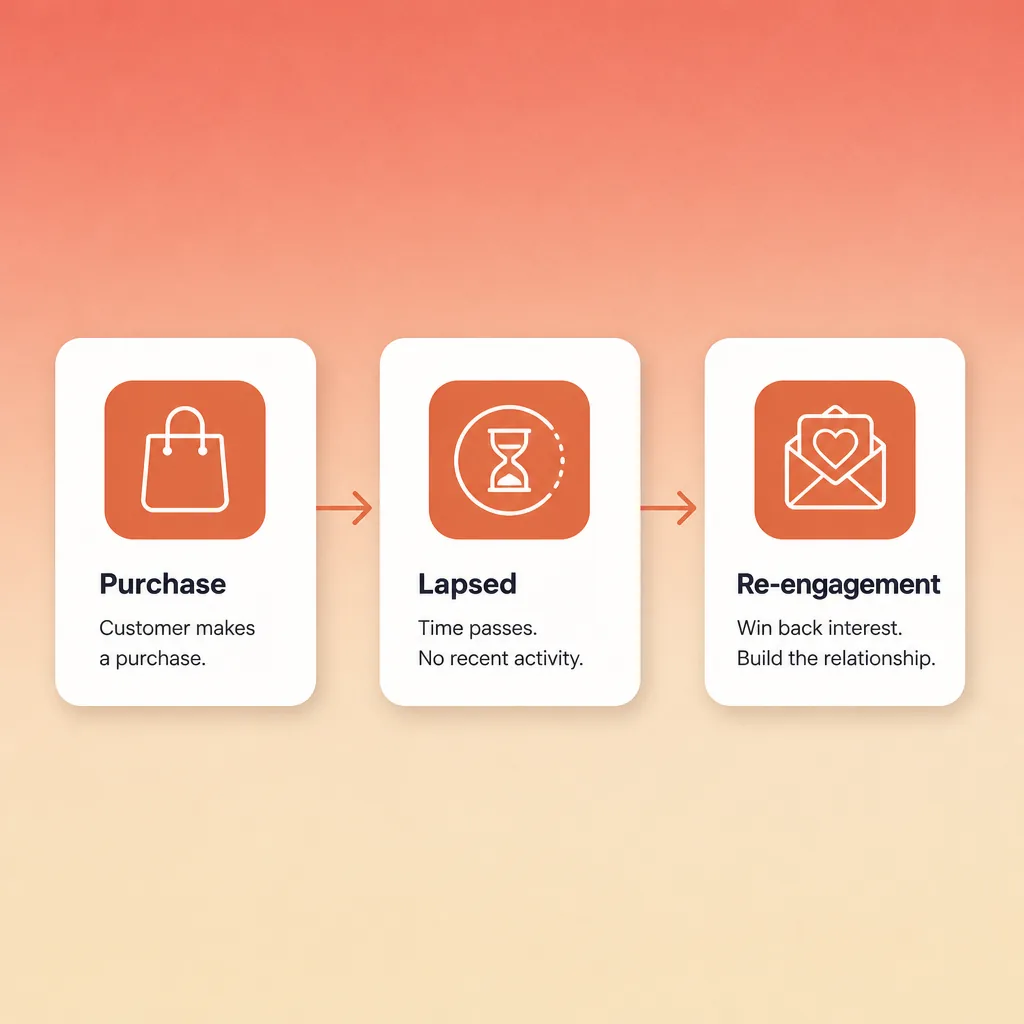
You spent money acquiring every customer on your list. Then they bought once and disappeared. It happens to every ecommerce brand: around 70 to 75 percent of first-time buyers never make a second purchase, because the average ecommerce repeat purchase rate sits near 25 to 30 percent, per Opensend's repeat purchase rate data.
The standard response is to spend more on acquisition. But by widely cited retention research, attracting a new customer costs five to 25 times as much as keeping an existing one, and repeat customers tend to spend more over their lifetime. The smarter move is to run a Klaviyo winback flow, an automated sequence that brings lapsed buyers back without manual effort.
The flow watches for customers who bought from you in the past but have not returned within a defined period, then emails them in sequence. When you add ChatGPT to personalise the subject lines, product recommendations and offers based on what each customer actually purchased, it stops feeling automated and starts sounding human.
What you need: Klaviyo with Shopify connected, ChatGPT and 90 days of orders
- A Klaviyo account with Shopify connected (the native integration syncs customer data, orders and products automatically)
- Access to the Klaviyo flow builder
- A ChatGPT account (ChatGPT Plus is enough for the personalisation step)
- At least 90 days of purchase history data (so Klaviyo's predictions have enough signal)
Step 1: Segment lapsed customers by purchase recency and value
Find the customers worth winning back
Not every lapsed customer is worth the same effort. Someone who spent three thousand dollars across five orders deserves a different approach than someone who bought a single discounted item eighteen months ago.
In Klaviyo, create a segment with these conditions:
- Placed Order - at least once
- Last Order Date - more than 90 days ago (start here, then adjust based on your buying cycle)
- Number of Orders - at least 2 (one-time buyers are harder to reactivate)
- Total Value - over AUD 100 (focus on high-value lapsed buyers first)
Klaviyo's dynamic segments update in real time as customers move in and out of the criteria. This keeps your list clean without manual maintenance.
Step 2: Calculate your win-back timing
Find the right time to reach out
The most common mistake is guessing the timing. A 90-day delay works for some stores but not others. The right number depends on your product and buying cycle.
Here is the proper method from Klaviyo's help docs: create a segment of everyone who has made at least two purchases in the last two years, export it as a CSV, and average the Average Time Between Orders column. That gives you your buying cycle. Then trigger your win-back flow at roughly 1.5 times that number.
If your customers typically reorder every 50 days, start the flow at 75 to 80 days. If they buy once a season, push it to 120 days. For high-ticket durable goods, 180 days or longer is normal.
Klaviyo's predictive analytics can help here too. The platform calculates a predicted next order date and churn risk score for each contact. Triggering your win-back based on expected date of next order has passed rather than a flat delay means every customer gets contacted at the right time for their individual pattern.
Step 3: Build the winback flow trigger
Set up the automation that starts the sequence
In the Klaviyo flow builder, click Create Flow and choose Build Your Own. Here is the setup:
- Trigger: Set the trigger to Placed Order under All Triggers > Metric.
- Filter: Add a profile filter: Placed Order zero times since starting this flow. This prevents customers who have already repurchased from receiving the win-back sequence.
- Time Delay: Add a time delay matching your buying cycle calculation from Step 2. Start at 90 days and adjust based on your data.
The trigger wait means the flow only activates when enough time has passed without a new purchase. If the customer buys something during the waiting period, they exit the flow automatically.
According to Klaviyo's own academy, a win-back flow is an automated way to proactively re-engage customers who are a churn risk. The key word is proactively: you are reaching out before they are gone for good.
Step 4: Write the first email, no discount yet
The soft reminder that welcomes them back
Klaviyo's official guidance recommends starting with social proof or reasons to buy rather than a monetary incentive. Customers who will come back at full price respond to the first email. Leading with a discount trains your list to wait for the coupon.
Your first email should include:
- A short, warm subject line referencing their past purchase (something like We noticed it has been a while)
- Three to six of your best-selling or newest products
- A simple CTA to browse what is new
- No discount code
Use ChatGPT to generate five subject line options. Pass the customer's past purchase categories into the prompt: Write five win-back email subject lines for a customer who previously bought [CATEGORY]. Make them warm but not desperate. This gives you personalised subject lines at zero extra effort per customer.
Step 5: Add ChatGPT personalisation at scale
Let AI write the personalised content for each segment
This is where the flow moves from standard automation to genuinely personal. Instead of sending the same win-back email to every lapsed customer, you can use ChatGPT to tailor the content based on what each person actually bought.
The workflow looks like this:
- Export your win-back segment from Klaviyo as a CSV with columns for customer name, last order date, total spend, and product categories purchased.
- For each row, send a ChatGPT API call with a prompt like: Write a 2-sentence personalised win-back email opener for [NAME], who last bought [CATEGORY] on [DATE]. Mention the product category naturally.
- Push the generated subject lines and openers back into Klaviyo as custom profile properties via the Klaviyo API.
- Use those properties in your email template with dynamic content blocks.
You do not need a developer for this. Tools like Make or n8n can connect Klaviyo to the ChatGPT API in about 20 minutes. Each API call costs less than a cent, and you only need to run it once per segment refresh.
Step 6: Build the discount escalation
Escalate from value to incentive
Space your emails 5 to 7 days apart. Here is the sequence:
Email 2 (Day 5-7): Value and social proof. Share customer reviews, UGC, or a why customers love us angle. Introduce new product launches. Answer the question: why should I come back?
Email 3 (Day 10-14): The incentive. This is where you bring the discount. Fifteen to twenty percent off plus free shipping is the standard that works. Make it feel exclusive — a gift for returning customers, not a coupon for anyone on the list.
Email 4 (Optional, Day 18-21): Last chance. Create urgency around the expiring offer and make it clear this is the final email before communication decreases. This also serves as a bridge to your sunset flow.
At any point during the sequence, if the customer places an order, the Placed Order filter pulls them out automatically. They never receive a win-back email after they have already come back.
Step 7: Add a conditional split for high-value customers
Separate VIPs from one-time buyers
High-value customers deserve a different experience. Use Klaviyo's conditional split to separate customers who have made more than three purchases or spent over a certain threshold:
- For high-value lapsed customers: offer a larger discount (20-25 percent off), express gratitude for their loyalty, and include personalised product recommendations from categories they buy from most.
- For lower-value lapsed customers: stick with the standard 15 percent off offer and focus on introducing new product categories they have not tried.
This split costs nothing to set up and improves reactivation rates because each customer sees a message that matches their relationship with your brand.
The benchmarks a working win-back flow hits
A well-optimised win-back flow changes the economics of your customer base. Here is what the benchmarks say:
- Automated win-back flows average a 42.5 percent open rate and 18 percent click-through rate, according to ConvertCart's ecommerce email marketing statistics.
- Per-send numbers are lower than campaign averages, which is normal. Flowium, a Klaviyo specialist agency, reports winback open rates near 29 percent, click-through near 4 percent, and orders from the first two emails at 0.9 to 1.4 percent of recipients. The flow earns its keep through reactivation rate, the share of entrants who buy again, not through per-send conversion.
- The reactivation rate for a well-segmented flow, meaning the share of people who enter it and then buy again, typically lands between 5 and 15 percent.
- Around 45 percent of subscribers who receive a win-back email go on to open future emails from the brand, even if they did not act on the win-back itself, per Validity's email reactivation research.
- Keeping an existing customer costs far less than acquiring a new one, so every recovered buyer is cheaper revenue than the next ad click.
The flow runs on autopilot once set up. Klaviyo handles the timing, the sequencing, and the exit logic. ChatGPT handles the personalisation. Your job is to check the reactivation rate once a month and adjust the offer strength if it dips below 5 percent.
Frequently asked questions
How long should I wait before sending a win-back email?
The standard is 1.5 times your average days between purchases. If customers typically reorder every 50 days, start your win-back flow at around 75 to 80 days. For consumable brands this might be 60 to 90 days; for high-ticket items it could stretch to 180 days or more.
Should I offer a discount in the first win-back email?
No. Klaviyo's official guidance recommends starting with social proof or reasons to buy rather than a discount. Customers who will come back at full price respond to the first email. Lead with a discount too early and you train your list to wait for coupons. Save the incentive for email three in the sequence.
How many emails should a win-back flow have?
Three to four emails spaced over 14 to 21 days. A common structure is: email one (soft reminder with new products), email two (social proof and value), email three (discount incentive), and an optional fourth email (last chance before sunset flow).
What happens if a customer still does not engage after the win-back flow?
They should enter a sunset flow, a final email warning that you will stop contacting them, and then be suppressed from future sends. This protects your sender reputation and keeps your email list healthy, as covered in the Klaviyo community discussion on win-back flow setup.
How do I know if my win-back flow is working?
Track reactivation rate (the percentage of flow entrants who purchase again). A 5 to 15 percent reactivation rate is typical for well-segmented flows. Also monitor open rates (around 42 percent for automated win-back flows) and click-through rates (around 18 percent).
Klaviyo's churn prediction model can help here too. It groups customers into low-risk and high-risk segments based on purchase behaviour, so you can send proactive offers before a customer becomes technically lapsed. For a broader look at how prediction fits into retention, our AI churn prediction guide covers the same signal-detection approach for subscription businesses.
And if you are deciding between email and SMS for your win-back sequence, our Klaviyo SMS vs email comparison breaks down which channel drives more revenue for each stage of the recovery flow.